
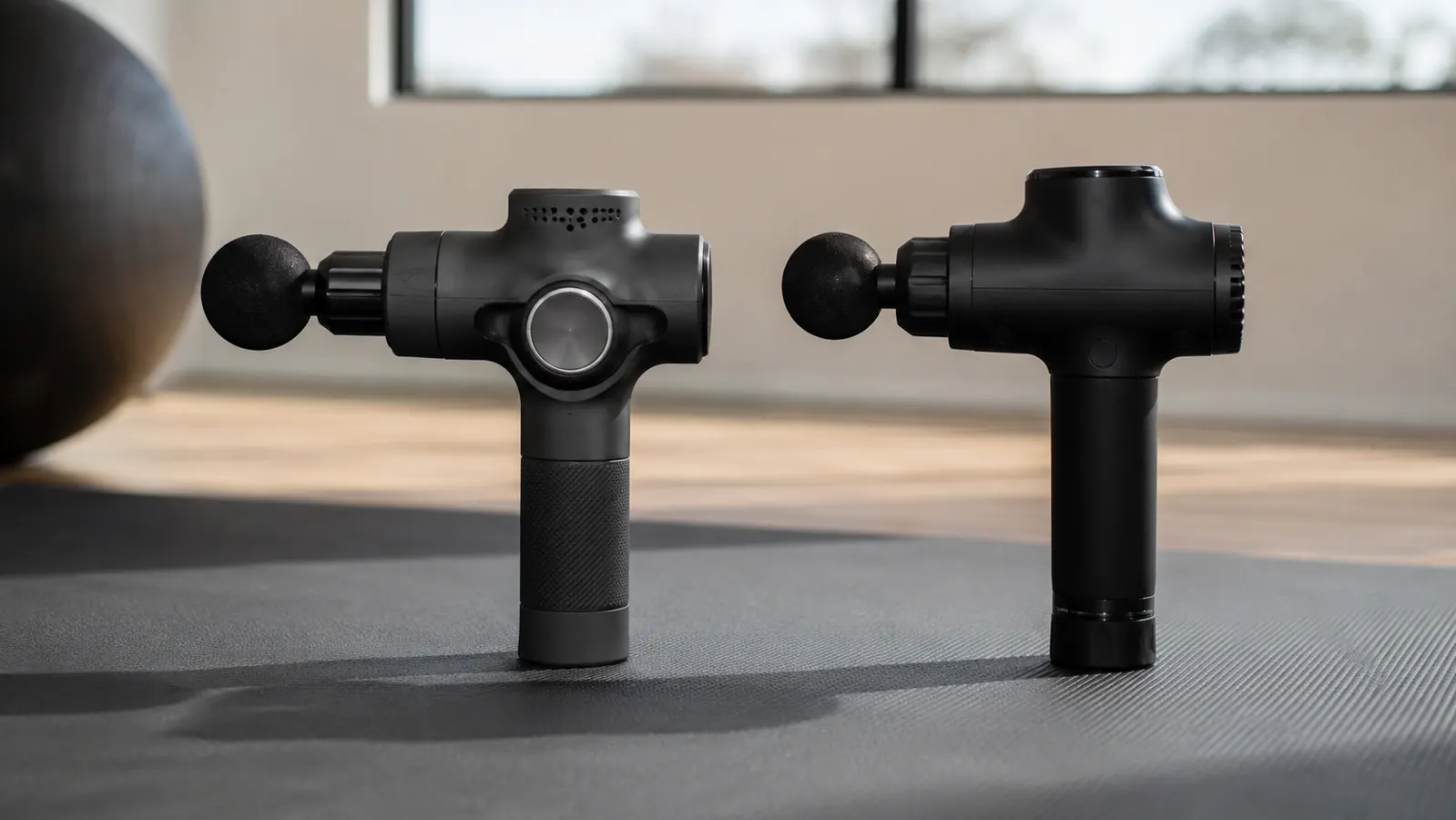
If you are standing at the edge of a premium Theragun Mini purchase wondering whether the name on the side is doing most of the work, I have been exactly where you are. I bought a Theragun Mini in January of last year after a brutal showing season left my feet and calves wrecked by Thursday of every week. It is a solid little device. It is also not worth twice the price of the Opove M3 Pro 2, which I picked up four months later and have used almost every day since. I kept both for a full month before making a call. This article is that call.
Short answer: the Opove M3 Pro 2 wins for most people who are not already locked into the Theragun app ecosystem. It hits harder, runs longer on a charge, and costs roughly half the price. The Theragun Mini's one genuine edge is size, and even there the difference is less dramatic than you might think.
| Opove M3 Pro 2 | Theragun Mini | |
|---|---|---|
| Price (retail) | Check today's price on Amazon | Check today's price on Amazon |
| Stall Force | 60 lbs | 20 lbs |
| Battery Life | 4-8 hours | ~150 minutes |
| Speed Settings | 5 levels (1800-3200 PPM) | 3 levels (1750-2400 PPM) |
| Noise Level | ~45 dB (quiet) | ~50-55 dB (moderate) |
| Weight | 2.2 lbs | 1.43 lbs |
| Amplitude (stroke depth) | 12 mm | 12 mm |
| Attachments Included | 6 heads | 2 heads |
| App Integration | None | Therabody app |
Where the Opove M3 Pro 2 Wins
The biggest difference between these two is stall force, and it matters more than the spec sheets make it sound. Stall force is how much pressure you can apply before the motor bogs down and stops. The Theragun Mini stalls at around 20 pounds of pressure. The Opove M3 Pro 2 holds at 60 pounds. In practice, that gap shows up every time you try to work into a really tight quad or a deep knot in the glute. With the Mini, you back off because the motor starts to labor. With the Opove, you can lean in. For someone like me whose calves turn to concrete after a long day of walking properties, the ability to actually stay on the sore spot without the gun cutting out made a noticeable difference in how quickly things loosened up.
Battery life is not even close. The Opove M3 Pro 2 advertises 4 to 8 hours on a charge depending on your speed setting. I have gone five days of nightly 10-minute sessions between charges. The Theragun Mini needs charging about every two to three sessions if you are using it daily. When I travel, the last thing I want to worry about is hunting down a charger in a hotel room at 10 PM. The Opove just sits in my bag ready to go. Six attachments versus two also means you have the right head for whatever you are working on: ball head for large muscle groups, flat head for dense tissue, bullet for trigger points. The Mini's two-head setup covers the basics but nothing more.
Where the Theragun Mini Wins
Size is real. The Theragun Mini is genuinely compact in a way that matters if your bag is already full. It weighs about 1.4 pounds versus 2.2 for the Opove, and it fits in the side pocket of a standard carry-on without any rearranging. If you are traveling constantly, taking red-eyes, running from showing to showing with a packed tote, that footprint matters. The Mini slips in without a second thought. The Opove fits in a bag too, but you will notice the weight difference.
The Therabody app is also a real feature if you are someone who responds to guided routines. It walks you through timed sessions by body part, tells you which attachment to use, and connects to the Mini via Bluetooth. If you are new to massage guns and you do not know where to start or how long to spend on each area, that structure is genuinely helpful. I did not need it after a few weeks of daily use, but for a beginner, it shortens the learning curve. If you already have a Therabody device and use the app regularly, staying in that ecosystem makes sense. For everyone else, it is a nice-to-have that does not justify the price premium.
Your calves are tight and you have got five minutes before the next showing.
The Opove M3 Pro 2 is the massage gun I reach for every single night. Stronger motor, longer battery, six attachments, and it runs quieter than the Theragun Mini at the same settings. Over 20,000 reviews on Amazon and rated 4.7 out of 5 stars.
Amazon Check Today's Price on Amazon →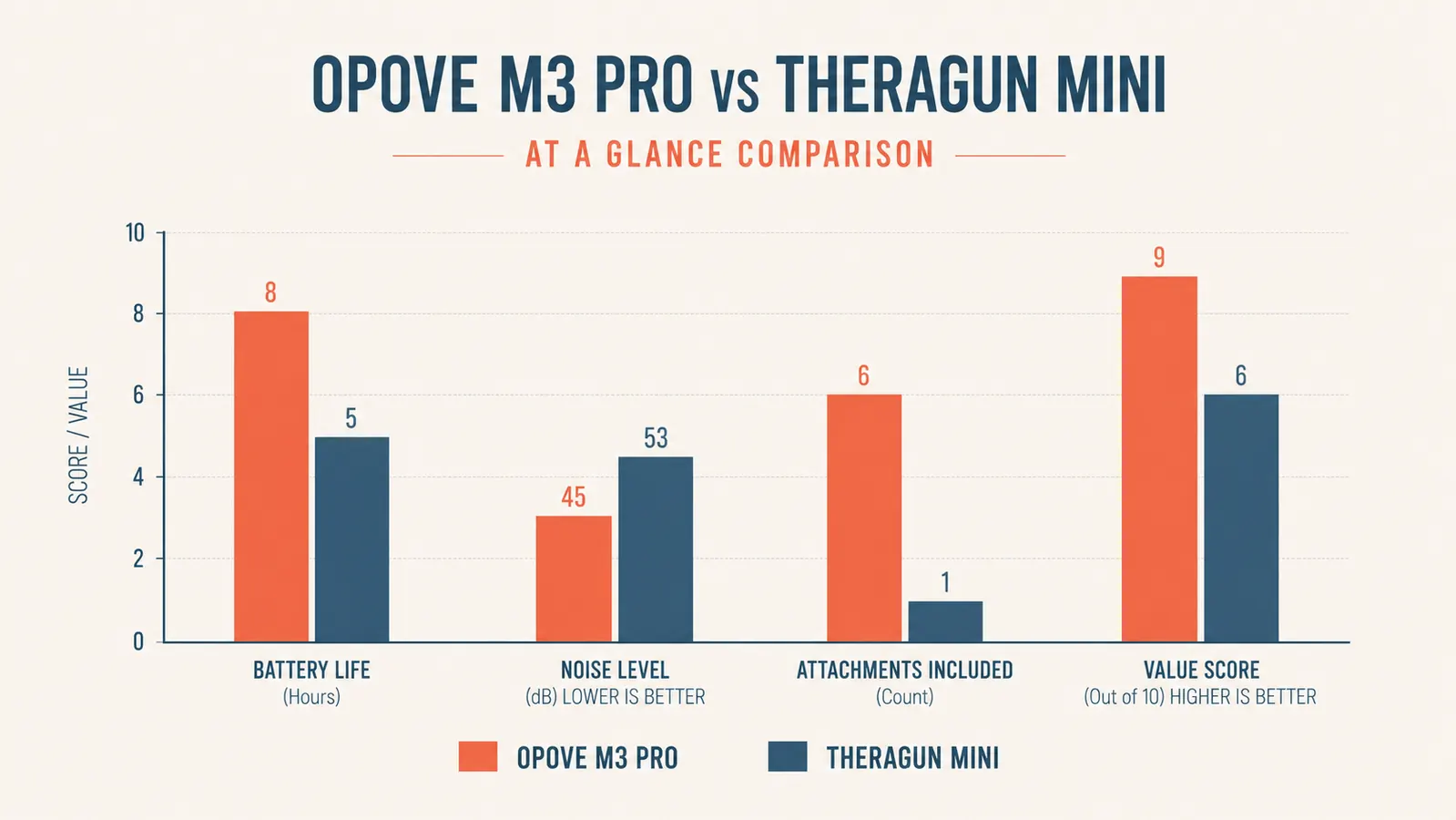
Head-to-Head: The Details That Actually Matter
Noise is a bigger factor than I expected. Massage guns are not silent, but there is a real difference between something that sounds like a power drill and something you can run during the evening news without your kids yelling from the other room. The Opove M3 Pro 2 runs at around 45 decibels on low-to-medium settings. The Theragun Mini runs hotter, especially at higher speeds. I noticed this most when I was using them in a hotel room late at night. The Opove let me work on my shoulders at medium speed without feeling like I was bothering anyone next door. That matters more than I would have guessed before I started traveling with a massage gun.
Speed range is another area where the Opove pulls ahead. Five speed settings from 1800 to 3200 percussions per minute gives you a real range: a gentle warm-up setting, a medium recovery setting, and a full-power treatment mode that can reach deep tissue. The Theragun Mini tops out at 2400 PPM with only three steps between low and high. Three levels is not necessarily a deal-breaker, but if you are working on different body parts with different needs, more control is better. My feet need a lighter touch than my upper traps. The Opove lets me dial that in.
I kept both guns for a month and used them on the same body parts at the same times. After 30 days I sold the Theragun Mini. Not because it is bad, but because every time I reached for a gun it was the Opove.

Who Should Buy Which
Buy the Opove M3 Pro 2 if you want the stronger gun at a lower price, you do not need app guidance to know where to use a massage gun, and you want a battery that lasts through a week of daily sessions without charging. That is most people reading this. At 4.7 stars across more than 20,000 Amazon reviews, the Opove M3 Pro 2 has earned its reputation with people who actually use these things every day, not just once a month after a workout. If you want to go deeper on what it is like to live with it, I wrote a full Opove M3 Pro 2 review covering three months of daily use that gets into the details.
Buy the Theragun Mini if you are already in the Therabody ecosystem, you regularly use the app for guided routines, and your carry-on is so packed that every ounce is a genuine constraint. Those are real situations. They just do not describe most people. If you are on the fence about the app and portability is only a mild preference, the Opove's advantages in power, battery, and price will matter more over six months of use.
One more thing worth knowing: I also wrote a deeper look at the Opove from a different angle in my Opove M3 Pro 2 honest review, where I specifically got into the battery life claims and whether they hold up with daily use. Short answer: they do, with some nuance.
Done second-guessing? The Opove M3 Pro 2 is ready when you are.
Stronger stall force, longer battery, quieter operation, six attachments, and a price point that is significantly lower than the Theragun Mini. This is the gun I use every night without exception. Check today's price on Amazon and see if there is a coupon clipped at checkout.
Amazon Check Today's Price on Amazon →