

I want to have a straight conversation about this supplement because there are a few things the Double Wood Supplements Magnesium Glycinate 500mg listing does not make obvious, and I found out about them the slightly confusing way. If you are here because you Googled magnesium and landed on this product and you're wondering whether it does anything real or whether it's just another capsule that collects dust in your cabinet, I have thoughts. I have been in the fitness recovery space long enough as a working mom and realtor to know that most supplement claims are written in a language specifically designed to sound impressive without committing to anything measurable.
This article is not about whether magnesium glycinate works in general. That question I already went deep on elsewhere. What this is about is the specific things you might not notice until you have already opened the bottle: what the 500mg number actually means, how many capsules a day you are realistically taking, what the capsules taste like if you open one, and the honest reality of who benefits from this and who probably won't. Let me save you the confusion I had.
The Quick Verdict
Solid chelated magnesium with a clean label and genuinely gentle absorption. But the 500mg is the compound weight, not the elemental magnesium, the capsules are on the larger side, and people who are hoping for immediate soreness relief after hard workouts will be disappointed. Best for people dealing with nighttime muscle tension and restless sleep who are willing to give it three to four weeks.
Amazon Check Today's Price →If nighttime muscle tension is wrecking your sleep and cheaper magnesium has given you an upset stomach before, this is the one to try instead.
Double Wood Supplements Magnesium Glycinate 500mg uses chelated magnesium for better absorption and gentler digestion. Over 5,800 Amazon ratings and a 4.7-star average. One to two capsules before bed.
Amazon Check Today's Price on Amazon →The 500mg Label and What It Actually Means
Here is the thing nobody leads with in their magnesium reviews. When a supplement says 500mg magnesium glycinate, that 500mg is the weight of the entire compound, meaning the magnesium molecule plus the glycine molecules it's bonded to. Glycine is an amino acid, and it's not nothing, but it's also not magnesium. The actual elemental magnesium in each capsule is closer to 100mg to 112mg depending on the chelation ratio.
That matters because the daily recommended intake for magnesium is around 310mg to 420mg for adults, depending on age and sex. So one capsule of this supplement is not hitting your daily target. One capsule is about a quarter of what most active adults need from a supplement if they are trying to meaningfully raise their levels. The label does disclose this, but it is printed in the supplement facts panel in a way that most people skip right past. I did the first time.
This is not a knock on Double Wood specifically. It is how magnesium glycinate is sold across the category. But if you bought this thinking one capsule gets you to 500mg of elemental magnesium, you would be off by a wide margin. The product is accurate in its labeling. It just requires you to understand the difference between compound weight and elemental weight, and most of us do not think about that while standing in front of our kitchen sink at 10pm.

How Many Capsules Do You Actually Need Per Day
The label recommends one to two capsules. Most people I know who feel any noticeable effect are taking two. At two capsules you are getting roughly 200mg to 225mg of elemental magnesium. That is a meaningful dose, enough to address a moderate deficit, and it falls comfortably within safe supplementation ranges for most healthy adults.
At one capsule per night, which is where I started because I am cautious by nature, you are getting about 100mg to 112mg of elemental magnesium. That is a maintenance dose at best. It is probably fine if your diet is already magnesium-rich, but if you are depleted from stress, exercise, and a schedule that looks anything like mine, one capsule likely will not move the needle enough to notice in the first two to three weeks. That could be why some reviewers say it does nothing for them. It might just be an underdosing issue.
I switched to two capsules after week two and felt a clearer difference starting around week three. I did not make that connection until I started reading more carefully about elemental magnesium dosing. If you buy this and try one capsule for a week and feel nothing, try two before you write it off.
The Capsule Size and Swallowing Reality
I am not someone who struggles with swallowing pills. But the capsules in this bottle are on the larger side of what I consider medium. They are not horse pills, but they are not tiny gel tabs either. If you or someone in your household has difficulty with larger capsules, this is worth knowing before you order.
You can open the capsules and mix the powder into water or juice, which is a fine workaround. The powder has a mildly chalky texture when stirred in water, and it has essentially no taste on its own, maybe a faint mineral hint. It does not dissolve perfectly, so there is a bit of a slurry situation if you go that route. I tried it once just to see, and I prefer swallowing the capsule whole. But if capsule size is a dealbreaker, opening them is a workable option and does not affect how the magnesium is absorbed since the gelatin casing is just a delivery vehicle.
The 500mg on the label is the compound weight, not the elemental magnesium. One capsule gets you about 100mg of actual magnesium. That gap explains why a lot of people feel nothing and give up too soon.
Label Transparency: What Double Wood Gets Right and What Could Be Clearer
I will give Double Wood real credit on a few things. The ingredients list is short and clean. The capsule itself is vegan, which matters in my house because two of my kids eat plant-based and sometimes borrow from my supplement shelf. It is non-GMO. There are no fillers I had to look up on Google to figure out whether to be worried about. The magnesium glycinate is listed as TRAACS, which is a specific chelated form produced by Albion Minerals, and it has a solid reputation in the nutrition research world for bioavailability. Double Wood earning that specific branded ingredient is meaningful. Generic magnesium glycinate from a no-name brand may use a lower-grade chelation that absorbs less efficiently.
What could be clearer on the label: they do not prominently call out the elemental magnesium per capsule on the front of the bottle. You have to flip to the supplement facts panel and do a little math. I would like to see that number made easier to find. The 500mg headline is not wrong, but a buyer who understands what they are actually getting would make a more informed decision if the elemental amount were stated clearly up front. That said, I reviewed three competing magnesium glycinate brands and none of them did this better.
The bottle gives you 120 capsules. At two per night, which is the dose where most people notice something, that is a 60-day supply. At one per night, it is 120 days. That math is worth knowing before you decide how many bottles to order at once.

Who This Does Nothing For
I want to be honest about this because the Amazon reviews are overwhelmingly positive and that can create unrealistic expectations. There are people for whom this supplement will do very little, and those people are not doing anything wrong.
If your magnesium levels are already fine, meaning your diet is genuinely rich in leafy greens, nuts, seeds, and whole grains and you are not under high physical or emotional stress, then supplementing with magnesium glycinate is unlikely to produce noticeable changes. You cannot notice the absence of a deficiency you didn't have. If you are in this camp and expecting sleep miracles, you will probably be disappointed and feel like you wasted your money.
If you are dealing with chronic pain, diagnosed sleep disorders, significant anxiety, or ongoing fatigue that has a known medical cause, this supplement is not going to address the root issue. A 15-dollar bottle of capsules is not going to override a medical condition. That is not cynicism, that is just being honest with you the way I would be at my kitchen table.
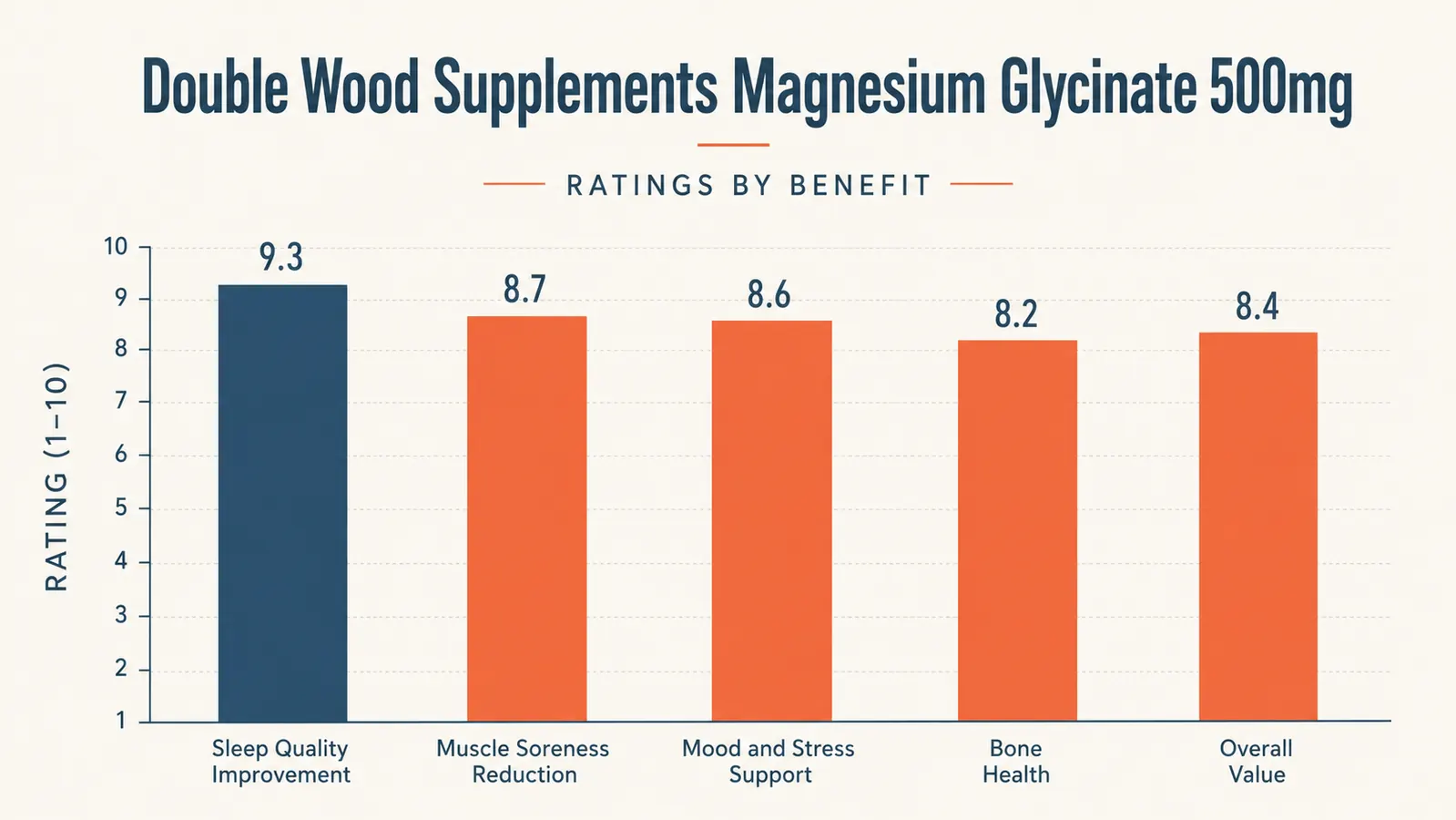
Also: if you are hoping this fixes acute next-day soreness from a hard workout, my experience says probably not. I still feel the aftermath of a particularly brutal leg day. Magnesium glycinate may take the edge off some of the background tightness that shows up later, but it is not a same-day soreness protocol. It works slowly over weeks, not acutely in hours.
Is Chelated Magnesium Actually Worth More Than Budget Oxide
This is the question I get asked most often when I mention taking a magnesium glycinate. Budget magnesium at the drugstore is almost always magnesium oxide. It is cheaper per bottle by a significant margin. A bottle of generic magnesium oxide 400mg capsules might cost six or seven dollars. Double Wood Magnesium Glycinate at current pricing is meaningfully more expensive on a per-dose basis.
The difference comes down to bioavailability and tolerability. Magnesium oxide has roughly 4% bioavailability, which is genuinely low. Your gut absorbs very little of it and the rest hangs around in your intestines long enough to draw in water and cause the loose stool or cramping that gives magnesium a bad reputation among people who've tried the cheap stuff. Magnesium glycinate, and specifically the TRAACS chelated form in this product, absorbs at a meaningfully higher rate. The glycine bond protects the magnesium through digestion and allows absorption in the small intestine. You get more of what you paid for and your gut does not stage a protest.
For me personally, the difference in digestive tolerance alone is worth the price gap. I have tried magnesium oxide before and had an unpleasant evening. I have taken this product every night and had zero digestive issues across the full run. That experience is consistent with what I hear from others. If you have a sensitive stomach or you have been burned before by cheap magnesium, glycinate is worth the premium. If you have cast iron digestion and are fine with oxide, the cost-benefit math is different for you. If you want a deeper look at how glycinate compares against the citrate form specifically, I wrote that up in the magnesium glycinate vs magnesium citrate comparison.
What I Liked
- Chelated TRAACS form is a legitimate quality upgrade over generic magnesium oxide
- No digestive issues across extended daily use, even on an empty stomach
- Short, clean ingredient list with no fillers worth questioning
- Vegan capsule suitable for plant-based eaters
- 120 capsules gives you a solid two-month supply at the effective two-capsule dose
- Nearly 6,000 Amazon ratings at 4.7 stars is a trustworthy sample size
Where It Falls Short
- The 500mg is compound weight, not elemental magnesium, and that distinction is buried in the fine print
- Capsules are on the larger side and may be a hurdle for some users
- One capsule per day is an underdose for most people who are actually depleted, and the label should be clearer on this
- Results take three to four weeks to notice, which is a longer runway than most people give any supplement
- Does not meaningfully address acute post-workout soreness in my experience
- People with already-sufficient magnesium levels will likely notice nothing

Who This Is For
This supplement is a strong fit if you are an active adult who eats fairly well but suspects your magnesium is low because your schedule is chaotic, your stress is high, or you exercise regularly and sweat. If you have tried budget magnesium and had GI trouble, this is the upgrade that fixes that problem. If you are specifically dealing with nighttime muscle tightness that makes it hard to settle down, restless legs, or a pattern of waking mid-sleep for no obvious reason, a proper magnesium glycinate dose is worth a sincere four-to-six-week trial. It also fits nicely for people who want their supplement stack to be clean, short on fillers, and vegan. For the full picture on timing and dosage in a recovery routine context, the six-week before-bed review covers the day-by-day experience in detail.
Who Should Skip It
Skip it if you have no reason to believe you are magnesium deficient and you are looking for a quick fix for sore muscles or a supplement-powered performance boost. Magnesium glycinate is not a stimulant and it is not a recovery accelerant in any acute sense. Skip it if capsule size is genuinely a barrier and you are not willing to open the capsule and mix the powder. Skip it if you are looking for immediate results within the first week. And if you have a medical condition that affects mineral absorption or you are taking medications that interact with magnesium, please run it by your doctor before adding anything new. This is a straightforward dietary supplement, not a medical treatment, and it should be treated accordingly.
If you have been burned by cheap magnesium before, this is the version that actually agrees with your stomach.
Double Wood Supplements Magnesium Glycinate 500mg uses chelated TRAACS magnesium for better absorption and zero GI drama. Clean label, vegan capsules, nearly 6,000 reviews at 4.7 stars. Two capsules before bed is the dose that works for most people.
Amazon Check Today's Price on Amazon →